


What to Write in Your Dive Log (and Why It's Worth It)
What to record after every dive: the essentials, the useful extras, and why a dive log helps with buoyancy, trips, courses and remembering what you saw.
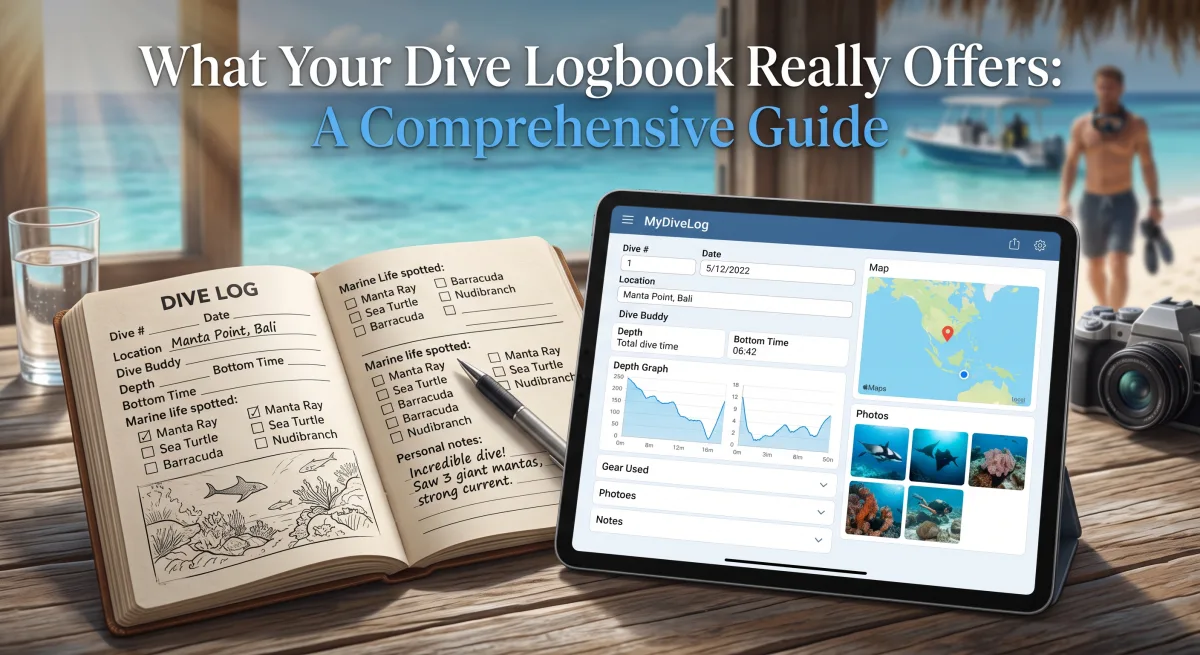
A dive log is easy to start and just as easy to stop. It is also the only record of what you have actually done underwater, and it takes a few minutes a dive to keep. Here is what is worth writing down, and why.
Why bother?
It is your proof of experience. Some of the best-known dive sites are not open to beginners, and even easy destinations may ask for proof of recent diving. A dive operator can only go on what you tell them, and a log is what backs it up. Without one, you may be offered a refresher course or put in a group of less experienced divers.
Courses and sites ask for numbers. Some advanced courses and dive sites want a minimum number of logged dives. PADI's Divemaster course, for example, needs 40 logged dives to start and 60 to certify.
It makes the next dive better. Write down how much weight you carried with which suit and cylinder, and you know where to start next time, which is a big part of good buoyancy. Note what broke or what you forgot, and it gets fixed before the next trip. Keep a list of what you saw, and you learn to recognise it and can plan to go back for it.
You will want it later. Dives blur together. A line or two about each one is what lets you remember, years from now, which dive was which.
What to write down
The essentials
PADI lists these as the basics of every entry:
- The date, the dive site and where it is, and the dive number
- Your total bottom time, your maximum depth and the surface interval before the dive
- What you wore (your exposure suit), and how much weight you carried and where
- The cylinder: its type and its size
- Any other equipment you used
- Your buddy's name and signature
- A comment or two about the dive
Worth adding when you can
- Temperatures: the air, the surface and at depth
- Visibility, and conditions such as waves, current and surge
- How you got in: from the shore or from a boat
- The breathing gas, and the cylinder pressure at the start and at the end of the dive
- The kind of water: sea, lake, quarry or river
- A stamp from the dive shop or dive centre
- Your cumulative bottom time
The start and end pressures are worth the effort: over a few dives they show you how fast you really use your air.
Write about the dive, not only the numbers
Many dive computers record depth, time and temperature for you. The part only you can write is the dive itself: what you saw, what went well, what you want to do better, anything unusual (a current that caught you out, a piece of kit that misbehaved), who you dived with and how it felt.
Keep a list of the animals you saw, and add the photo number if you took one. If you can't name something, write down what it looked like (its shape, its markings, its size, where it was) and look it up afterwards, or upload the photo to the AI fish identifier. Our tips for photographing fish make that much easier.
Make it a habit
Write it up the same day, while you still remember it. Copy the depth, time and temperature from your dive computer if it keeps them, and spend the rest of your minutes on what it can't know. A paper logbook and an app both work: the one you keep up is the right one. If you want a dive to count as proof, ask your buddy or dive guide to sign it. PADI's advice is that a signed entry is what makes it valid.
The few-minutes version. If you only manage four things, write the date and the site, the depth and the time, what you wore and how much weight you carried, and one line about what you saw.
After a break
If you have been out of the water for a while, your log answers the question every dive shop asks: when did you last dive, and how much have you done? Skills can fade after as little as six months, and most dive educators consider a year or two enough to suggest a refresher, according to Divers Alert Network. Say so honestly and let the shop decide what you need.
Your ScubaSnap log
ScubaSnap has a free dive logbook that follows this list. It has room for the dive site and date, whether you dived from the shore or a boat, depth and bottom time, the conditions (water, weather, temperatures, visibility, waves, current and surge), your equipment (suit, weight, cylinder, gas and pressures), how you felt about the dive, your notes, your buddy and dive centre, and photos. You can save a dive as a draft and finish it later. You need a free account: use the Register button at the top of the page.
The short version
- Date, site and dive number
- Bottom time, maximum depth and surface interval
- Suit, weight and cylinder
- Temperatures, visibility and conditions
- Pressure at the start and at the end
- What you saw, what went well and what to change
- A signature from your buddy or guide
- Written up the same day
Planning the next trip? Browse dive sites and countries on the destinations page, and write the dive down when you are back.
Sources and further reading
- How to Log a Dive (PADI): what to record, signatures and proof of experience.
- Why Keeping a Logbook Will Help Make You a Better Diver (PADI): weight, equipment and sightings.
- PADI Divemaster Requirements (PADI): the number of logged dives.
- Can't Answer These Scuba Questions? It's Time for a Refresher Course (PADI, quoting Divers Alert Network): how long a break is too long.